Input and Output Characteristics
The energy of optical pulses has to be measured.
A PIN diode is used to convert these optical pulses into electrical current pulses. At the wavelength of the optical signal, the conversion gain of this PIN diode is 0.05 A/W. Its small-signal impedance is inaccurately known and strongly depends on the voltage. At zero volt it is approximately 6 nF. The anode of this diode should be grounded. The reverse bias voltage should not exceed 1V. At this voltage the leakage current (dark current) of the diode is smaller tnat 50nA.
The maximum repetition rate of the pulses is 100k pulses per second. The start of a pulse occurs about 0.5-1 us after a trigger. The maximum pulse power is 20mW and the maximum optical energy is 2nJ. 97% Of the energy is contained in a time span of 2us.
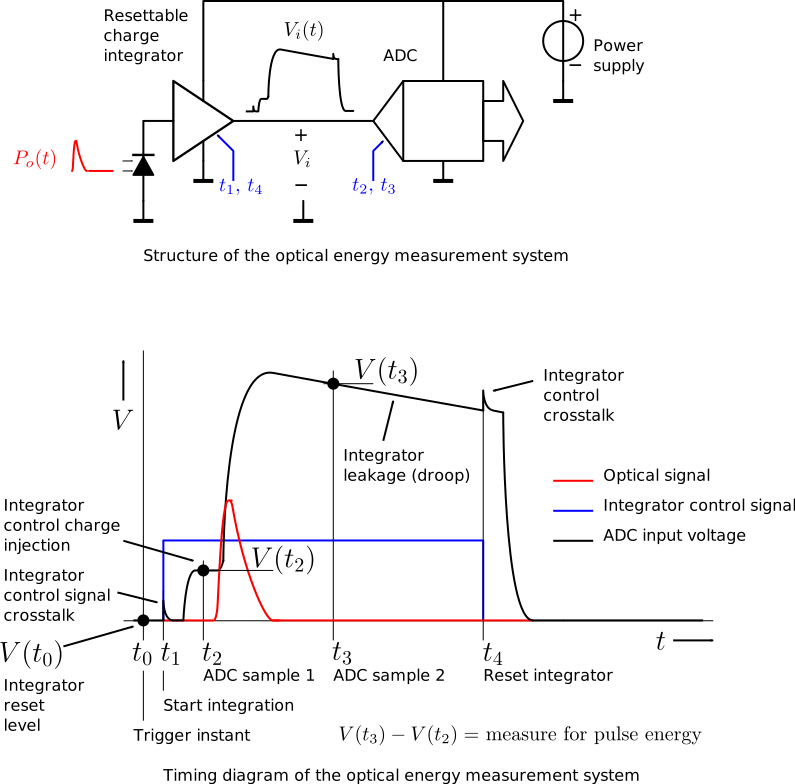
An ADC with an input voltage range equal to its power supply is used to measure the pulse energy. A correlated double sampling (CDS) measurement scheme is used to reduce the effects of low- frequency noise and drift, as well as adverse effects caused by the analog front-end.
A resettable charge integrator is used to convert the current pulses from the pin diode into a voltage that is an accurate measure for the pulse energy. The relative inaccuracy of the charge to voltage conversion should be less than 20%. The resolution of the energy measurement system should be at least 500pJ. the Corralated Double Sampling techniques is used to reduce the influences of integrator errors.
The system should be realized in SMD technology and operate at a power supply of 3.3V +/-5%. The power dissipation of the complete system should be less than 250mW. A low-noise power supply with a noise spectral density below 5nV/rt(Hz) and a total RMS noise less than 10uV is available.
The system has to operate according to the above specifications over a temperature range from 20 - 70 degrees Celsius.
Go to Project-Data
SLiCAP: Symbolic Linear Circuit Analysis Program, Version 1.3.0 © 2009-2022 SLiCAP development team
For documentation, examples, support, updates and courses please visit: analog-electronics.tudelft.nl
Last project update: 2022-11-20 18:08:04