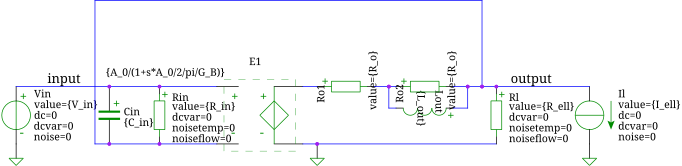
Schematic diagram used For Resistance Modeling
When the feedback is connected in parallel with the output the short circuit loop gain is zero so our total output impedance is written as:
\begin{equation} Z_{o}=\frac{\rho}{1 - L_{o}} \end{equation}The Direct Transfer at the output port is:
\begin{equation} \rho=\frac{R_{\ell} R_{in} R_{o} \left(- 2 L_{out} s - R_{o}\right)}{2 C_{in} L_{out} R_{\ell} R_{in} R_{o} s^{2} + R_{\ell} R_{in} R_{o} + R_{o}^{2} \left(R_{\ell} + R_{in}\right) + s \left(C_{in} R_{\ell} R_{in} R_{o}^{2} + L_{out} R_{\ell} R_{in} + 2 L_{out} R_{o} \left(R_{\ell} + R_{in}\right)\right)} \end{equation}The Loop Gain at the output port is:
\begin{equation} L_{o}=\frac{2 \pi A_{0} G_{B} R_{\ell} R_{in} \left(- L_{out} s - R_{o}\right)}{2 A_{0} C_{in} L_{out} R_{\ell} R_{in} R_{o} s^{3} + 2 \pi G_{B} R_{o} \left(R_{\ell} R_{in} + R_{o} \left(R_{\ell} + R_{in}\right)\right) + s^{2} \left(A_{0} C_{in} R_{\ell} R_{in} R_{o}^{2} + A_{0} L_{out} R_{\ell} R_{in} + 2 A_{0} L_{out} R_{o} \left(R_{\ell} + R_{in}\right) + 4 \pi C_{in} G_{B} L_{out} R_{\ell} R_{in} R_{o}\right) + s \left(A_{0} R_{\ell} R_{in} R_{o} + A_{0} R_{o}^{2} \left(R_{\ell} + R_{in}\right) + 2 \pi G_{B} \left(C_{in} R_{\ell} R_{in} R_{o}^{2} + L_{out} R_{\ell} R_{in} + 2 L_{out} R_{o} \left(R_{\ell} + R_{in}\right)\right)\right)} \end{equation}The DC impedance is:
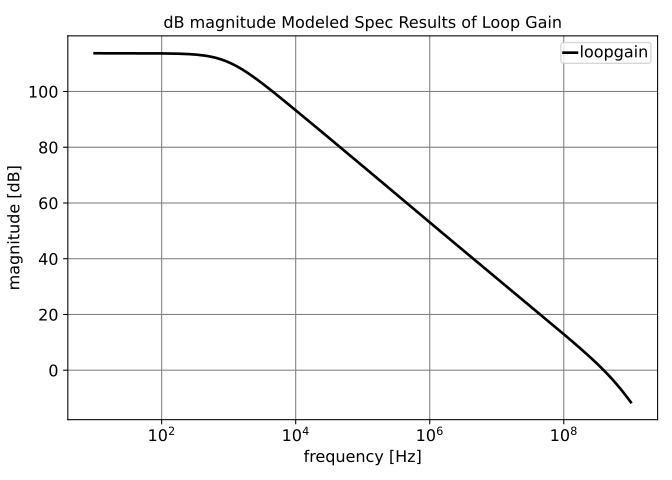
\begin{equation} Z_{odc}=- \frac{R_{\ell} R_{in} R_{o}}{A_{0} R_{\ell} R_{in} + R_{\ell} R_{in} + R_{\ell} R_{o} + R_{in} R_{o}} \end{equation}From the Gain Plot we see that at 55.0dB the frequency is about 850000.0 this leads to a 1st Order GBW of 477990126.4117967
The DC Gain of the Op-Amp is 114.0dB so the first pole of the op amp occurs at 953.715686156669
This pole is a zero in the output impedance Z_o; so for a first order rise:
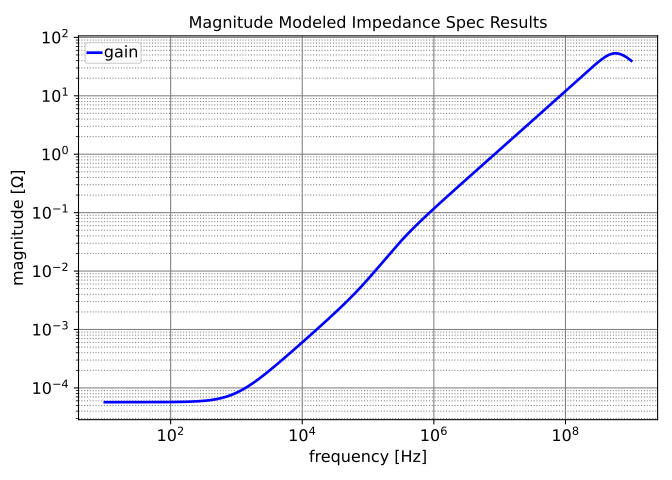
\begin{equation} Z_{o}=Z_{odc} \left(1 + \frac{s}{p_{1}}\right) \end{equation}From our data sheet at 10.0kHz the Impedance is 0.6$m\Omega$ Now I find that:
\begin{equation} R_{o}=28.55\,\left[ \mathrm{\Omega}\right] \end{equation}Now that the Output Resistance is determined I can solve for the output inductance.
At 500.0kHz the impedance is 0.021$\Omega$
Past the first zero the impedance function is:
\begin{equation} Z_{o}=Z_{odc} \left(1 + \frac{s}{p_{1}}\right) \left(\frac{s}{z_{2}} + 1\right) \end{equation}The Magnitude of $z_2$ can be approximated as:
\begin{equation} z_{2}=\frac{Z_{odc} w^{2}}{Z_{o} p_{1}} \end{equation} \begin{equation} z_{2}=\frac{3.555 \cdot 10^{5}}{\pi}\,\left[ \mathrm{Hz}\right] \end{equation}From the direct transfer it is clear the zero due to the inductance is:
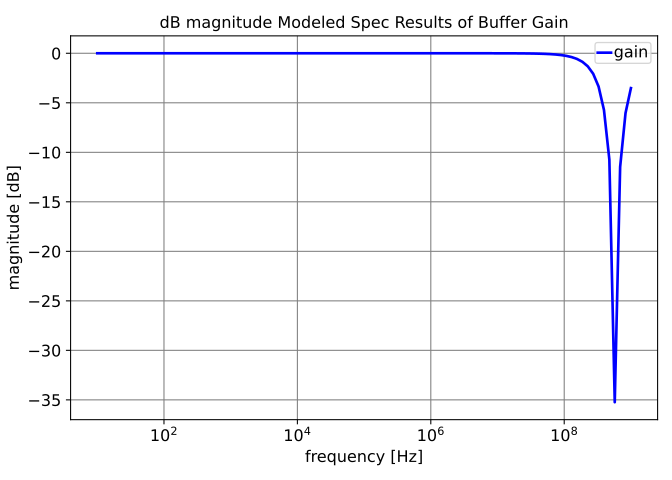
\begin{equation} z_{2}=\frac{R_{o}}{2 L_{out}} \end{equation} \begin{equation} L_{out}=2.008 \cdot 10^{-5}\,\left[ \mathrm{H}\right] \end{equation}There is a capacitance at frequencies around 100MHz but this is not of interest since our signal is below 1MHz.
Go to Op-Amp-Output-Impedance-Model_index
SLiCAP: Symbolic Linear Circuit Analysis Program, Version 1.3.0 © 2009-2022 SLiCAP development team
For documentation, examples, support, updates and courses please visit: analog-electronics.tudelft.nl
Last project update: 2022-11-20 18:08:04